23 May, 2022
Comfrey Through the Ages
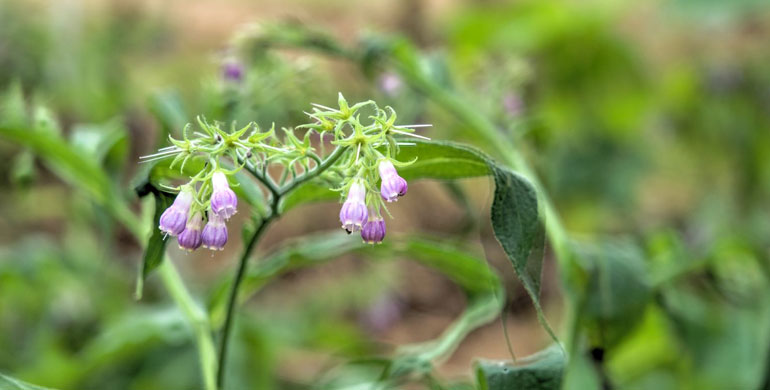
Comfrey Plant OriginsThe Comfrey(Symphytum spp.) plantbelongs to the borage family,and its rootscan be found in Europe and Asia.Its name comes from a Latin word that means to ‘grow together’ because it has the potency to bind things together. The Russian Comfreyis often found in gardens across the world, which is a hybrid version of two of its species.
It has been grown and farmed in the European and Asian regions since 400 BCand has 40 of its species spread across the two continents. Its medicinal value has helped to retain its popularity through the ages. The cultivation of the plant in ancient times began in Britain and Central Asia. Later, the European migrants took the herb to the United States of America and other parts of the world.
The roots, leaves and rhizomes of Comfrey are used to treat several ailments, including cough, mouth ulcers, chest pain, gum disease, preventing heavy bleeding, etc. The practice of using it as a medicine has been going on for 2,000 years because of its pain-relieving and anti-inflammatory properties. Since it is used to heal broken bones, it is also known as knitbone and boneset.
Historic Mentions of ComfreyThe oldest mention of Comfrey can be found in an ancient phytomedicine book, Naturalis Historia,which was written by Pliny the Elder, a Roman author, naturalist and natural philosopher. The book states that the plantcan be used to heal bruises and sprains. In addition, it describes that the herb is effective in quick healing of injuriesand can help toincrease menstrual flow when crushed and mixed with dark wine.
Another book from the same era, Materia Medica, written by Dioscorides, states that when crushed into a fine powder and consumed, Comfrey aids in healing internal abscesses.It also mentions that the herb can be used as a compress to cover fresh abrasions and injuries on the skin.
Usage During the Middle AgesDuring the Middle Ages (5th to 15th Century), Comfrey was mentioned in Nicholas Culpeper’s book, The English Physitian. He stated that the plant could be used for the treatment of rheumatism and gout. According to him, the herb had powerful joining properties that weresuccessful in healing internal wounds and external injuries. He also describes its usage in treating spitting of blood, urinating blood, muscle slashes, broken bones, bruises, nerve abrasions, pain in joints, etc. Besides this book, there were several other authors who wrote about Comfrey and its uses in a similar manner.
During the Middle Ages, Comfrey became a part of the diet and was even fed to cattle. It was widely used as food in Ireland whenthe country was affected by the potato famine in the early 1800s. The plant, when soaked in rainwater, produces a potent fertiliser that helped to grow potatoes and tomatoes and became a staple among farmers. English scientist and horticulturist Henry Doubleday (1810-1902) also promoted Comfrey as food and fodder.
The Progressive Era (1901-2000)In the Twentieth Century, there were several mentions of Comfrey across publications,and all of them supported the use of the herb for bone fractures, inflammation, peptic ulcers, coagulation, haematoma, external injuries, diarrhoea, pain and swelling of joints, cough, bronchitis, etc. It was also propagated as a food and forage crop by British horticulturalist and writer Lawrence Donegan Hills (1911–1990) in the UK. He started the comfrey research program in Bocking and was able to discover the most nutrient-rich strain, which was named Bocking 14. The species was transported throughout the world and became a part of the gardens.
In the later part of the 20th Century, the molecular constituents of the plant were identified,and it was established that Comfrey contains pyrrolizidine alkaloids. These are considered damaging for human consumption because of their carcinogenic nature and impact on the liver. Thus, the consumption of unprocessed herb has been restricted ever since. Currently, only licenced preparations are allowed, which are made from roots that have a permissible limit of alkaloids.
Wrapping UpComfreyis presently used for external injuries, sprains, pain, muscle pulls, etc. Several researchers are still working on the development of topical formulations using Comfrey, and some of their published work describes Comfrey root extract to be a potent topical analgesic for sprains.


